Wednesday, July 21, 2010

What Does Low Hemoglobin Level Mean

DINA (part 3)

1990's


Once privatized
DINA Group, was appointed as its Director General Mr. Ernesto Moya Pedroza. The direction of the Bus Division was by Eng Javer Rion Del Olmo Francisco.

DINA With privatization, there were some domestic competitors in the assembly of foreign buses. TradeMe that it had discontinued production of the Sultan returned to the production of these new models. Omnibus de Mexico that was not satisfied with the bus DINA, formed his own bus assembly plant in the city of their birth, Aguascalientes, the company Omnibus Integrales, SA de CV (OISA).


DINA already privatized initially continued production of the Avante buses and Gold Plus. Below is a brochure of these buses, but now with its new brand image.


taken from Tecnibuses Brochures. Courtesy of Luis Manuel Robledo


Dina Group began in 1992 to manufacture bus platforms and Viaggio Paradiso. This through an agreement with Marcopolo, the Brazilian company source world leader in the manufacture of chassis for buses.


taken from Tecnibuses Brochures. Courtesy of Luis Manuel Robledo

In that same 1992, the Mexican market demanded 3 000 809 foreign buses. DINA assemble these 165 billion, which represented 31%, to be the leader in this field. Of total company sales by 68 percent assembly represented sales of trucks, 31 percent of sales of buses, and about 1 percent were sales of other products.


begin in 1993 exports to Central and South America in 1994 are DINA Composites, SA de CV in order to develop technologies for the automotive plastics, Group G acquires assembly plants Motor Coach Industries International to facilitate exports the North American market.

The outlook for early 1994 looked wonders for the Mexican company. In this regard a columnist for the newspaper El Norte (Monterrey, NL) wrote: "Four years ago, the government got rid of a parastatal company lost $ 25 million annually manufacturing trucks and vans that smoking could barely climb mountains of Mexico. "


"That same company, Consorcio Grupo Dina, is now managed by a team of entrepreneurs and get annual earnings of $ 90 million thanks to a new line of trucks and vans."

"Now has become the largest manufacturer of trucks in the United States, Motor Coach Industries International, based in Phoenix, Arizona, in a stock transaction worth 336 million dollars. "


"Many analysts were surprised that a Mexican company, especially one with a shaky past, transborder conduct the first major acquisition in the new era of free trade between the United States, Canada and Mexico."

"Because Motor Coach Industries has operations in Canada, the acquisition creates one of the first new North American companies since the adoption of the Free Commerce in Washington and indicates that Mexican businesses at all are waiting to be acquired by U.S. companies once the FTA comes into effect on January first. "

In 1994, the bus plant had a capacity to produce 16 units per day, ie about 3 buses a year in 1500


Photos taken from the Bus Ride Magazine, January 1994

Aerial View Group Dina in Ciudad Sahagun, Hidalgo.

Photo taken from the Bus Ride magazine, January 1994


Photo tomda Buses journal, July-August 1994

However, after four good years with the ratification of NAFTA, manufacturing trucks and buses in Mexico had enormous changes, including a marked increase in competition from foreign firms, especially in the manufacture of trucks.


Mercedes Benz (MB) who had entered the Mexican market as a business partner Famsa truck maker, decided to fully enter the bus market to set up a plant in 1994, NL MB imported from Brazil the famous O371.

Between December 1994 and August 1995 there were continuous changes in Group management DINA. Moya Pedroza was replaced by Alejandro Trejo Giordano, who began a corporate restructuring that included general downsizing.

Subsequently, on March 7, 1995 Alejandro Giordano resigned and his place was taken by Wilfrido Gonzalez Balboa, who led the corporate business controlled Gómez Flores family.
Baloboa
González left office on 16 August 1995 and was replaced by George W. Aucott, who served as CEO of Motor Coach Industries International, a subsidiary of Dina in the U.S. and Canada, which was merged in August 1994. Aucott

had served previously as president and general manager Dina subsidiary, Motor Coach Industries, Inc. (MCII), and has over 30 years of experience in the field. Aucott, who made his retirement effective March 31, 1996. Rafael Gomez Flores, president of Consorcio G Grupo Dina temporarily assumed the general direction of the company, replacing George W. Aucott.
.
On October 1, 1997 was opened in Mercedes, Argentina a new truck factory, in a strategy of integration into the Mercosur.

The plant opened by the Argentine President, Carlos Menem, who promised to make all efforts to the establishment of a free trade area between Mexico and Mercosur, the customs union that Argentina shares with Brazil, Paraguay and Uruguay. The subsidiary in Argentina called Dimex and was 100 west of Buenos Aires.

DINA late 1997 in an exhibition showed a range of heavy vehicles, from buses sophisticated to the trucks. Among the most prominent foreign MCII bus appeared Model F-11 of 11 000 mm long, equipped with Detroit Diesel Engine IV DDC 50 series 4-cylinder with electronic injection, 320 hp @ 2,100 rpm, torque torsional 1.150 Lb-ft @ 1,200 rpm.
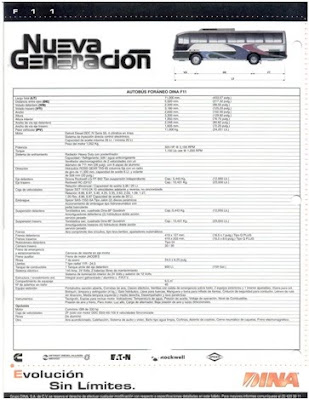

Brochure Tecnibuses taken

In 1998 the bus was released 12miles F12 200 mm long, equipped with Detroit Diesel Engine IV DDC Series 60, 6 cylinders in line. Direct injection system, electronic control, 370 Hp, `torsional torque of 1450 lb-ft @ 1200 rpm.


Brochure Tecnibuses taken


In 1999 he DINA model F14 bus, the bus 13 000 275 mm long, equipped with 6-cylinder Cummins engine.


Brochure Tecnibuses taken


1990'se the late 2000's early entered the Mexican market TNCs: International (1998), Scania (1999 ), Man (2002), manufacturers of platforms for buses and Marco Polo (2000), Irizar (1998), and Busscar (1999) Body manufacturers. In the case of International that had been DINA technology partner and after TradeMe, built its own plant in Mexico to manufacture tractors. In 1998 Volvo acquired the assets of the formerly state-owned Mexicana de Autobuses (Masa-Somex).


Now with more competition and a large debt, DINA sold his shares of MCII in June 1999 to an investment firm in New York.

2000's


workers the company began one of many strikes on October 6, 2000, which was extended until March 6, 2001.

died in March 2001 Rafael Gomez Don Oscar Flores Chairman of the Board of Directors of Group G.

Strong union pressures, financial turmoil, stiff competition and economic slowdown administrative errors were the factors that acted against the Mexican automotive assembly plant that ended close to filing for bankruptcy in September 2001.

After leaving the market for technical bankruptcy, DINA back to this in 2008, now under the direction of Guillermo Gomez Flores. Initially, two models were manufactured buses.

The resumption of production involved an investment of more than $ 100 million in its first stage and the creation of 450 direct and 750 indirect jobs. The company began with five distributors: in the capital, Monterrey, Guadalajara, Leon and Oaxaca, the majority of former licensees of the brand.

The company currently produces five models of 4 of which are for urban use: Runner, Linner Linner G and Picker. To use foreign manufactures the 594 Outsider mimimetros 10mil in total length, equipped with Cummins ISB 200 HP @ 2,300 rpm and torque of 520 lb-ft @ 1,600 rpm.


Brochure DINA site taken

should be noted that so far has not been made public that Dinah has any intention of returning to the production of freight equipment.

far this unofficial history of a Mexican company with nearly half a century. Information contained herein are designed exclusively for the production of buses DINA, though in certain sections of felt necessary to mention other teams assembled by the same motor.

The information contained in this third part was obtained from newspaper sources, mainly newspapers: El Norte (Monterrey, NL), El Porvenir (Monterrey, NL) and The Reporter (Guadalajara, Jal.). Other data were obtained from published information on the company network.

For any questions or comments I remain. José Ramírez Lozano

Monterrey, NL Mexico
.

Fruit Pulps Versus Extracts

DINA (Part 2)


1960's (continued)


Mr. Gustavo Diaz Ordaz served as President of Mexico in the period from 1964 to 1970. During this period he was appointed Director of National Diesel Mr. Gustavo Solorzano.


DINA in 1968 began production of the NH and NT engines with Cummins technology. That same year he began making the 323-G1 Dina bus, Flxliner model replica of The Flxible Corporation. This model was popularly known Olimpico cone, since the market emerged in the year of the XIX Olympic Games held of the modern era in Mexico City.


The 323-G1 Dina had capacity for 41 passengers and was equipped with DD 8V-71 engine with maximum power of 318 HP, Fuller gearbox 5 speed and reverse.


Brochure provided by Robert L. Smith


The following photograph published the newspaper El Porvenir on March 16, 1968 shows an aerial view of National Diesel. In the background shows other plant in Ciudad Sahagun, were all state property.


1970's


In the seventies you start a new presidential term in Mexico (1970-1976), the Lic Luis Echeverria Alvarez. From 1970 to 1972, the Directorate General of DINA was given by Mr. Jesus Reyes Heroles.Posteriormente, Diesel Nacional, SA (DINA), Siderurgica Nacional SA (Siden) and Constructora Nacional de Carros de Ferrocarril, SA (CONCARRIL) were integrated into a single entity called Combined Industrial Sahagun (CIS). In 1972 he was assigned as its Director General Lic Kieger Emilio Vazquez.


The November 6, 1974 were inaugurated the facilities of National Automotive Maquiladora (MAN) installed in Escobedo, NL, in which before had been the National Automobile Factory, SA (FANAS) that will produce up to four Borgward car years ago. MAN was integrated into the CIS.


MAN
production was for the assembly of pickup trucks under the brand DINA models 1000, 3000 and 3200, all powered by International Model Scout. Later DINA trucks were manufactured with a body similar to Chevrolet Custom. MAN truck production ended in 1983.


In 1976 the incoming President of Mexico Mr. Jose Lopez Portillo (1976-1982) initially confirmed as Director of CIS to Mr. Kieger Vázquez. Shortly after Mr. López Portillo appointed as Director General Francisco Javier Alejo.


Later in 1979, during the same six years of Mr. Lopez Portillo, the CIS was restructured some companies became Somex Group under the direction of Mr. Mario Ramon Beteta and others Dieesel Nacional SA led by Mr. Ricardo Garcia Sainz.

1980's

In this decade were to happen events of great importance in the Mexican motor carriers. Other than in the early years of the same companies managed by the State (DINA and MASA) would monopolize the production of buses for foreign use.

Dina Buses in 1981 was 717 and MASS other foreign bus 484.


The unfair competition from those firms to sell their units below its real price and the sharp recession of 1982 "chasing" for private investment in this area, example of this was that the other large trucking , suspended TradeMe the manufacture of buses Sultana.


With the administration of President Mr. Miguel de la Madrid Hurtado (1982-1988), in December 1982 was appointed as Director Guillermo Arreola Becker Diesel Nacional, SA In 1986 Becker became the Directorate Arreola Siderúrgica Mexicana (Sidermex), taking its place Mosconi Mr. Humberto Castillo.


Since 1982 Diesel Nacional, SA (DINA) operated as an entity holding company and parent company, with participation in twelve companies in the automotive industry as a whole parastatal and exercising direct control over ten of them. Of these five came from the former DINA specialized divisions, three were transferred in previous years by the Group SOMEX and two were joint ventures with foreign companies.


industry DINA terminal comprised three companies: a) Bus Dina, SA de CV (DASA) dedicated to comprehensive foreign bus assembly class, b) Trucks Dina, SA de CA, (DICAS ) whose line was headed to the assembly of trucks and tractors; c) Mexicana de Autobuses, ASVC (MASA) is also dedicated to the assembly of integral buses, both second-class and urban and trolleybuses.


DASA in 1982 reduced production to 672 units completed in 1983 fell to 244 in 1984 achieved a slight recovery to produce 350. The years 1985 and 1986 were remarkable recovery to produce 787 and 689 units. However, this trend was interrupted in 1986, before the worsening economic downturn, inflation and the scarcity of credit, registering an unprecedented drop in domestic demand for vehicles. Such was the fall in the Annual Report of Work (1986-1987) of the company predicted production of only 157 units completed for 1987. It should make the observation that in the same report mentions that the installed capacity of 1.300 days was occupied units completed annually and to 1.158 workers in 1986.


The Olympic DINA continued in production with some slight changes to the late 1980's.
330-G5 model was equipped with DD 6V-92TA engine with maximum power of 330 HP, Spicer gearbox 5 speed and reverse.


Brochure provided by Robert L. Smith


Of the 157 completed units planned for 1987, 97 were model 330 and 60 were of a new bus line identified as D-350 G-7 better known as the Avante.


The Dina Avante out of their defenses was a replica of the Eagle 15. The Avante was equipped with DD 6V-92TA engine, rated at 330 HP, gearbox Spicer 7-speed and reverse. The total length was 10 thousand 909 millimeters


Brochure provided by Robert L. Smith


The Avante suffered changes in driving an emerging source Avante bus Plus.Otro introduced comprehensive foreign use in the late 1980's was the Dina Dorado. Below are the features and technical data Avante both Plus and the Dorado.


taken Tecnibuses Prospectus. Courtesy of Luis Manuel Robledo


The Avante Plus had a length of 10 000 910 mm and capacity for 42 passengers, while Golden had a length of 12 thousand 180 mm up to 49 passengers. As a prime mover, the Avante was equipped with DDC Series 50 engine and engine DDC Dorado series 60.

At the end of this administration, Dina, who was born in Mexico auto giant had to face a very difficult situation to put him on the verge of bankruptcy. De540 foreign debt billion prevented him from having the resources to modernize its industrial plant and its models.


addition, the economic crisis reduced to almost zero demand for its main products (passenger and freight trucks and diesel engines).


Another serious problem was the lack of agreement between the company and union to modify its labor contracts and increase productivity.

Thus ended DINA the six years to produce 95 percent fewer trucks in 1981, 98 percent fewer buses and 90 percent less engines.


During that time staff was reduced from 14 thousand to 6 thousand 500 employees, equivalent to a plunge of 55 percent.


85 percent of its installed capacity was unused due to lack of maintenance and repairs and start-up could cost up to $ 200 million.


For these reasons, the federal government chose to sell the company to losses take heavy investment that would be required to make it produce, which will have to make the Private Sector,''said A source close to the parastatal group.

Between 1987 and 1988 Dina sold three of its divisions to the private sector. Dina The Cummins engine plant, was sold to the foreign partner, the American company Cummins.

Rockwell Dina, a supplier of heavy transport industry was transferred to the Monterrey industrial Lozano Rodolfo Barrera, former director general of the group Cemex.


Mexicana de Autobuses, who was about to be liquidated for lack of orders to manufacture passenger trucks, was sold to Samuel Wigisser Karpul carrier.

Already during the presidency of the Republic in charge of Mr. Carlos Salinas de Gortari (1988-1994). In August 1989, were put up for tender in one package 4 of the companies that once were part of DINA. These companies were DASA, tips, Dina Automotive Plastics, SA de CV (PADS) and Dina Motors, SA de CV (DIMOTSA).

The October 31, 1989 the four companies were sold to Consorcio G is a group of Mexican businessmen based in Guadalajara, Jal., Then headed by Mr. Omar Raymundo Gómez Flores. Thus ends this stage of 38 years in the DINA was a company controlled by Mexican state.


Pedrola
Ernesto Moya, was recruited from a financial services company City Mexico and appointed General Director of the DINA privatized.

So far the second part of this work.

To make this second newspaper sources were consulted, including the newspapers El Porvenir (Monterrey, NL), El Norte (Monterrey, NL) and The Reporter (Guadalajara, Jal.). We also recorded DINA Annual Report 1986-1987. The brochures are listed in this second part I was provided by Robet L. Smith and Luis Manuel Robledo


Any questions or doubts I'm here to serve

José Ramírez Lozano Monterrey, NL Mexico.

Friday, June 11, 2010

Baby Ishower Template

UNI-IES FAIR advance Banners

The presentation of projects of the Fair held at the IES-UNI, it failed to show the progress of the project REGIONAL TRANSPORT TERMINAL Of Carazo, making sastifactoriamente first in the category of architectural.