Nicoya Guanacaste TILARAN
S1800
NICOYA
Thursday, October 28, 2010
My Baby Has Torticollis And Club Foot

MERCEDES BENZ
Nicoya

ANTHEM STYLE FD194SA
Nicoya
Nicoya

INTERNATIONAL Loadstar 1700
Nicoya
Nicoya

Autotransport MENARA
THOMAS ENGINE CATERPILLAR
Tilarán
THOMAS ENGINE CATERPILLAR
Tilarán

THOMAS B71033
TRANSPORT VILLAN Tilarán
TRANSPORT VILLAN Tilarán

THOMAS T LINER
CUMMINS
CUMMINS

THOMAS MOTOR COMPANY THOMAS MARVEL

DINA - MERCEDES BENZ MOTOR
Photographs 
provided by Mr. Cesar Mora

provided by Mr. Cesar Mora
THANKS FOR VISITING 

Tuesday, October 12, 2010
Sweetened Cocoa Powder Brownies
Blue Bird de Mexico, SA de CV Monterrey


Photos taken from http://articulo.mercadolibre.com.mx/MLM-28335568-venta-de-autobus-blue-bird-2002-_JM


Blue Bird de Mexico, SA de CV
Blue Bird de Mexico, SA de CV ( BBM) was an American home assembly company specializing in buses for city and school. The production was mainly oriented to export.
On September 14, 1995, the tour made by President Nuevo León Ernesto Zedillo Ponce de León inaugurated the assembly plant, located in Apodaca, located northeast of Monterrey metropolitan area.
Blue Bird de Mexico, SA de CV ( BBM) was an American home assembly company specializing in buses for city and school. The production was mainly oriented to export.
On September 14, 1995, the tour made by President Nuevo León Ernesto Zedillo Ponce de León inaugurated the assembly plant, located in Apodaca, located northeast of Monterrey metropolitan area.
The company initially employed 29 workers. The general direction of the company's corporate office was Paul E. Glaske, and general management of the plant in Nuevo Leon, under Anthony Sellier.
The first 20 buses assembled in Apodaca came to Haiti in October of that year. Anthony Sellier, said at the time, that the Corporation would sell this year about 15 000 buses in 50 countries, representing about 500 million dollars.
The story of Blue Bird ( BB) Albert Luce starts when built in 1927, Blue Bird # 1, one of the first school buses steel used in construction and established a new paradigm in the school transportation industry .
In 1935 he was commissioned in Fort Valley Georgia under the name of Blue Bird Body Company's first plant dedicated to the bus. The plant was destroyed by fire in 1945. In 1946 a new plant started operations as well as corporate.
In 1935 he was commissioned in Fort Valley Georgia under the name of Blue Bird Body Company's first plant dedicated to the bus. The plant was destroyed by fire in 1945. In 1946 a new plant started operations as well as corporate.
Blue Bird became an international manufacturer of school buses with the start-up of Blue Bird Bantford Canada in Ontario in 1958. In 1965 the company its first plant in Latin America, in Guatemala, which ceased operations in 1982.
Blue Bird Corporation (BB) had five modern factories in the United States and Canada when it was put into operation in Apodaca. The production of the Corporation was in buses for urban, suburban, school, commercial and recreational vehicles, one of the leaders in these markets. Thanks to the facility in Apodaca, Nuevo León, BB could enter the market.
neoleonesa
The plant had an area of \u200b\u200b11 thousand square meters. The production capacity of this plant was up to three thousand units per year to settle in national manufacturing platform.
The plant had an area of \u200b\u200b11 thousand square meters. The production capacity of this plant was up to three thousand units per year to settle in national manufacturing platform.
buses for school use are classified as Type A with a maximum capacity of 30 aciento, Type C also called convensional up to 48 seats and type D up to 90 seats. The plant in Apodaca was convensional type buses.
The following photos are a bus Blue Bird TC 2002 for urban use in service in the city of Veracruz, Veracruz, Mexico.
Photos taken from http://articulo.mercadolibre.com.mx/MLM-28335568-venta-de-autobus-blue-bird-2002-_JM
The following is a Blue Bird FE 5200 A for school use, model 1999, 46 seats, 11.5m long, Cummins Engine, online, power 177Hp (130kW), diesel, turbo, interkuller, injector , volume - 5900cm3, number of cylinders - 6 euro - 2., Gearbox Allison MT 643, automatic, 4x2 axles, air suspension, power steering, air conditioning, seats, braking system: ABS.
In year 2001, Blue Bird closed its plant in Apodaca. Currently 5 plants of BB located in the United States remains only operating the Forth Valley Georgia rebuilt in 1946. The Canadian operations closed in 2007.
 BB in October 2009 entered into partnership with the Canadian manufacturer of school buses Girardin Minibus. That company is called Micro Bird, Inc. But that is another story.
Sources: Blue Bird Corporation
article published online in http://www.reference.com/browse/Blue_Bird_Corporation .
EZ Plant Opens Blue Bird. Article published by the newspaper El Porvenir on September 15, 1995. Blue Bird
comes to Mexico. Report in the newspaper El Norte on October 6, 1995.
article published online in http://www.reference.com/browse/Blue_Bird_Corporation .
EZ Plant Opens Blue Bird. Article published by the newspaper El Porvenir on September 15, 1995. Blue Bird
comes to Mexico. Report in the newspaper El Norte on October 6, 1995.
Dejan Apodaca eight companies, affecting 3 000. Article published by the newspaper El Norte on 17 June 2002.
For any comment or clarification from you
José Ramírez Lozano Monterrey, NL Mexico
Friday, October 8, 2010
How Long Can Hearing Loss Last
Mercedes-Benz and Polomex (part 3)




In the second part of this work mentioned that Mercedes Benz Mexico (MBM ) was associated with the Brazilian company Marcopolo to assemble buses thus comprehensive service both urban, suburban as foreign. This company called Polomex is attached to venues MB manufactures platforms for these buses. The facility was reinauradas in 2002.
also mentioned that in 2004 MBM changed its name to Daimler-Chrysler Mexico Commercial Vehicles ( DCVCM ) and three years after the sale of Chrysler, the company changed to Daimler Commercial Vehicles Mexico ( DVCM ). Polomex continued to date with this name.
In 2009, Daimler Buses sold around 32.500 units globally, ie 20% drop compared to previous years record. However, as a group llogró maintain its global leadership with 13% share market.The German market remained at 2008 levels, Daimler Buses maintained its market share by 60%. In Western Europe the market was down 5%, making its market share reached 30%.
In Brazil, the industry had a greater reduction, with a market 15% lower sales versus 2008. Daimler Buses was able to increase its market share 2 percentage points to stand at 50%. In Mexico, the market's decline deepened by different circumstances and was closed the year with 50% drop in total volume. So, fell to 11.104 units sold in 2008 to only 5.552 in 2009, foreign bus segment most affected by a decrease in volume of 58% compared to 2008 sales. The fall of the urban sector was lower but no longer important, as decreased by 54% compared to last year's sales.
Buses Mercedes-Benz Mexico achieved a turnover of 2.819 units in 2009, maintaining its lead in market share to 51%, consolidating its market leadership for over a decade. What history has taught us the crisis in Mexico is that normal levels of sales of buses do not recover in less than 4 or 5 years so that by 2010 could only expect a modest recovery of around 20%.
In October 2009, Mercedes-Benz Plant Monterrey celebrated its 15th anniversary. During the ceremony handing over the unit number 50 000 (Toriono OH) Lazcano Group.

in 1999 were launched new products on XBC rear engine chassis, for the urban segment of the new Torino OH, and for the Allied underground, and the introduction of a new OH 2836 articles with Euro 5.
 Torino OH. Photo taken from http://www.autobusesmercedesbenz.com.mx/home/contenidos_productos

Allied. Photo taken from http://www.autobusesmercedesbenz.com.mx/home/contenidos_productos
Harald Hauke \u200b\u200breplaced from January 1 2010 to Jochen Duppui. Jochen Duppui, who since January 2007 was responsible for DVCM Bus Division took on new responsibilities in the area of \u200b\u200bproduction in Germany. Paul Schmidt is the Director General of Polomex.
Working at 50 percent capacity in one shift, the facilities of the MB-MP pair can produce up to 16 platforms and 13 buses full of day. The bus line's confrman 4 models for urban use (Boxer, Boxer OF, OH and Gran Viale Torino), 1 model for suburban use (there) and 3 models for use foreign (Turiclass, walking and Multego)
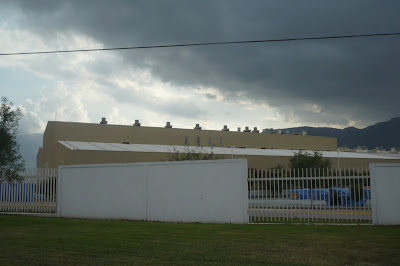
The following pictures were taken at outdoor facilities MB Polomex Monterrey plant.


Photos by Eva M. Ramirez Quezada
For the preparation of this third part of the network took data published by Mercedes Benz buses http://www.autobusesmercedesbenz.com.mx/home/
Any commentsor suggestions I remain
José Ramírez Lozano
Monterrey, NL Mexico
Subscribe to:
Posts (Atom)